
Art and Architecture - UH Manoa Campus
I love exploring college campuses and UH Manoa is special to me since it’s right around the corner from where I grew up. Though I didn’t attend college at UH, all my siblings did. I wonder if they noticed the great public art there. Here is a sampling.
RISE by Bumpei Akaji
1979, Bronze and Copper
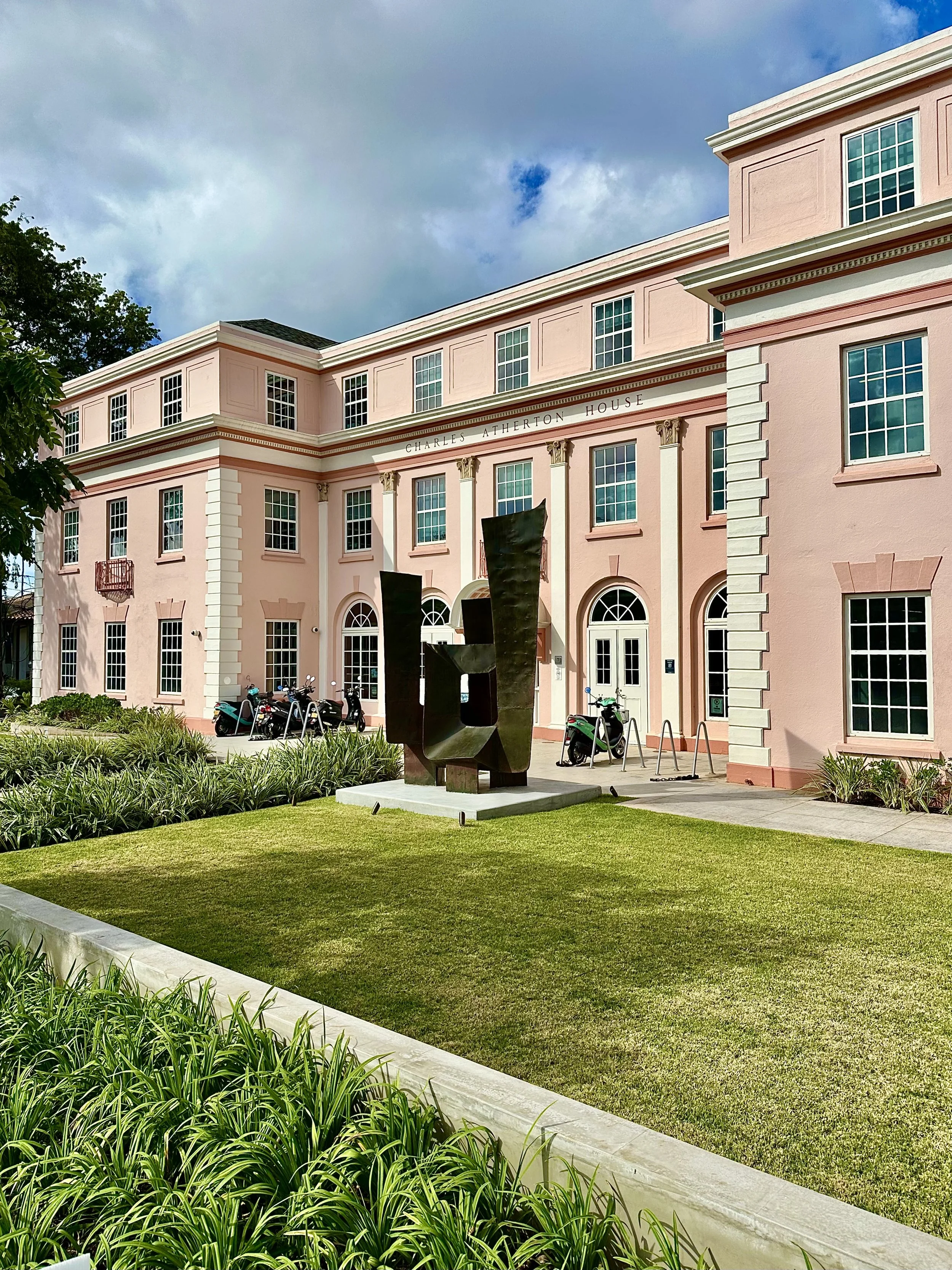
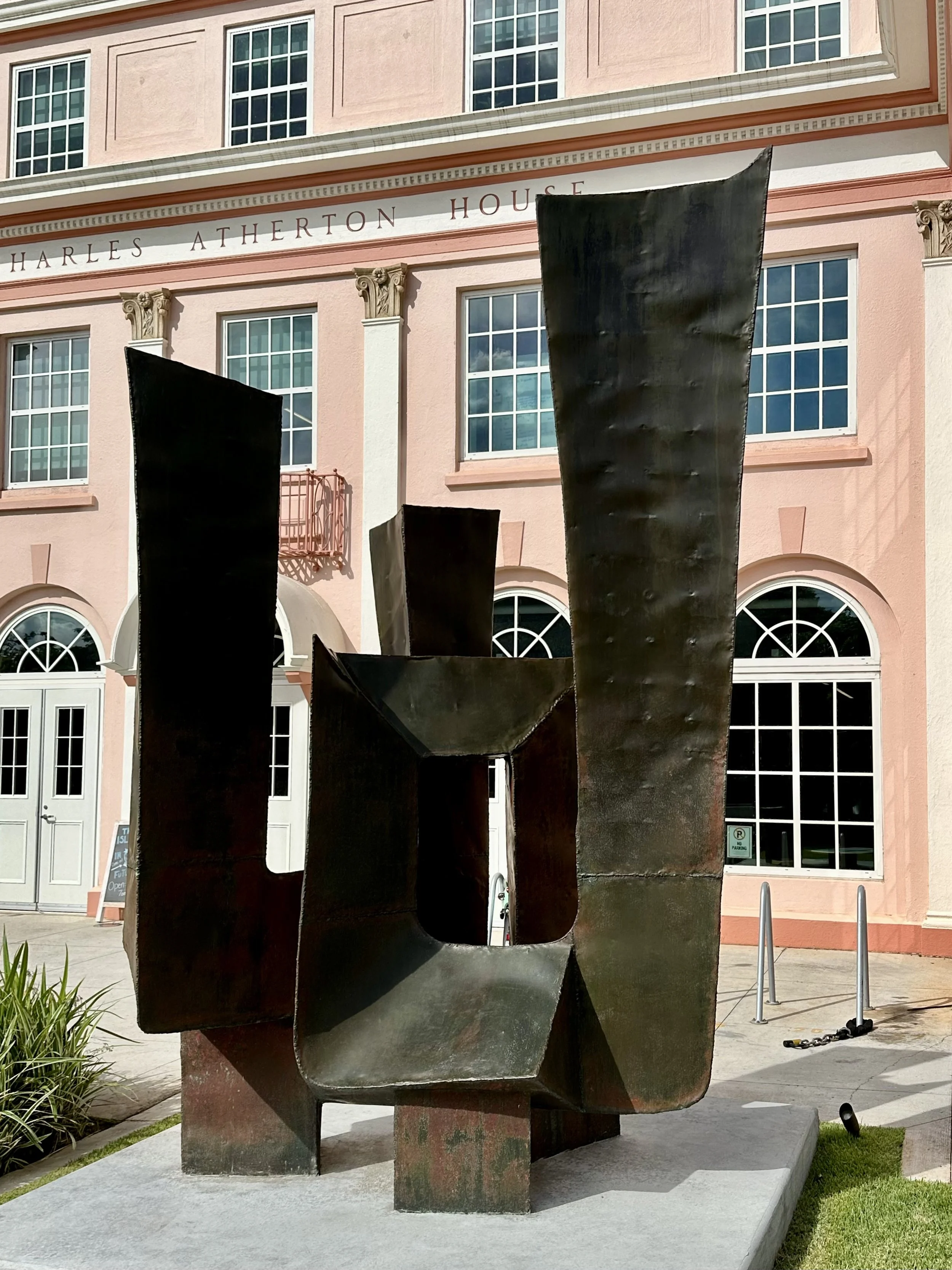
Anyone driving by University Ave. and Metcalf has surely noticed this pink building that would be at home on an episode of Bridgerton. I dropped by Island Brew inside the former YMCA building for an iced coffee drink. But first, I took a moment to appreciate the sculpture outside.
The sculpture “RISE” was created in 1979 by Kauaʻi-born artist Bumpei Akaji as a gift for the late Masaru Yokouchi, founding chairperson of Hawaiʻi’s State Foundation on Culture and the Arts. University alums Walter Dods, Jr. and Jay H. Shidler purchased the sculpture from Yokouchi’s estate on Maui. Dods named it “RISE” with permission from Yokouchi’s family.
Description of Atherton House from Library of Congress:
The Charles Atherton House is significant for its association with the history of the YMCA on Oahu and the University of Hawaii at Manoa. The building is also significant as an example of an Italian Renaissance structure with subtle Georgian Style design influences by a prominent Honolulu architect, Guy N. Rothwell. The original design featured a steel roof deck covered with textured shingles; both were innovative for Hawaii.
To the nth Power (1971) by C.W. Watson
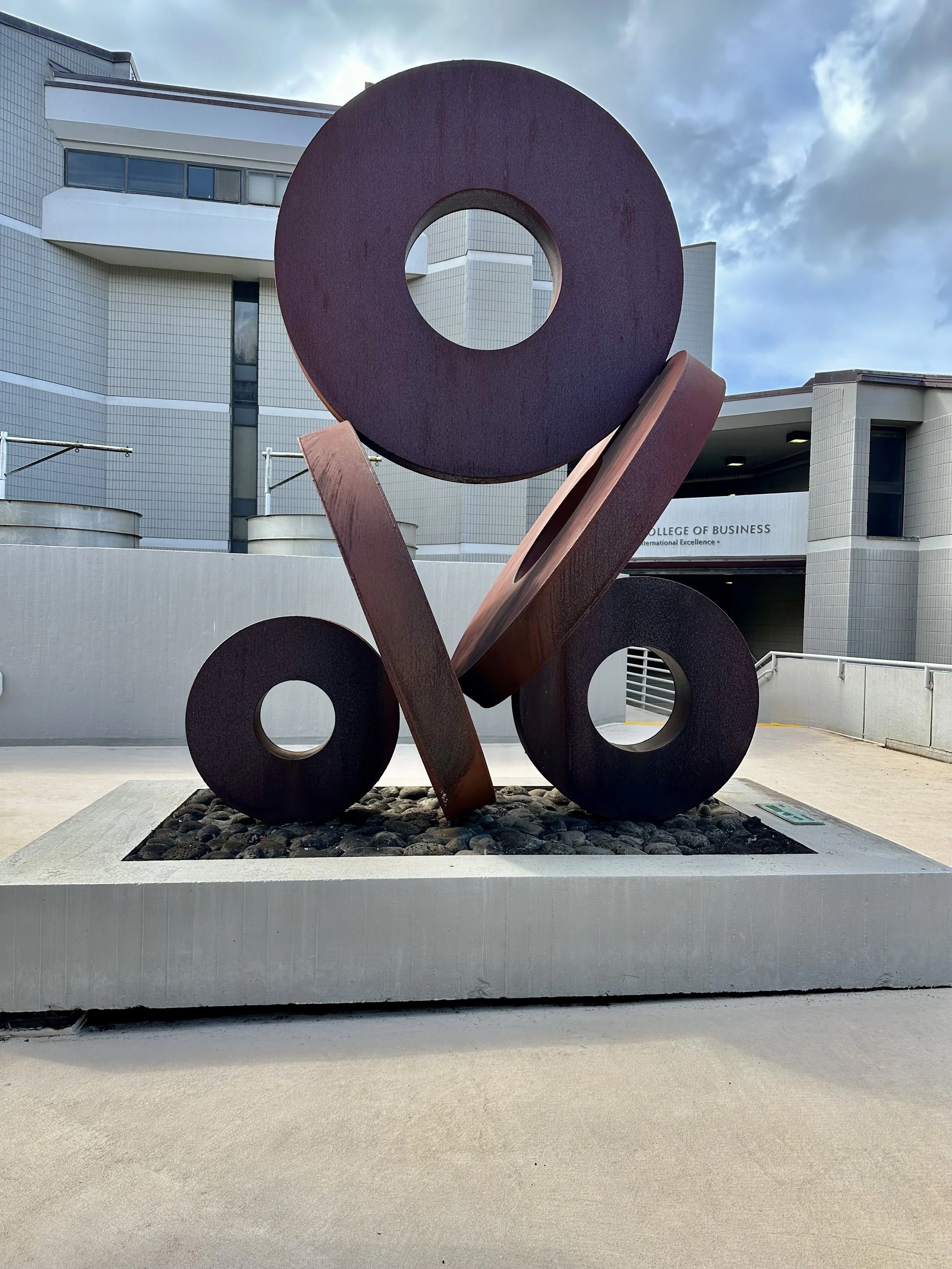
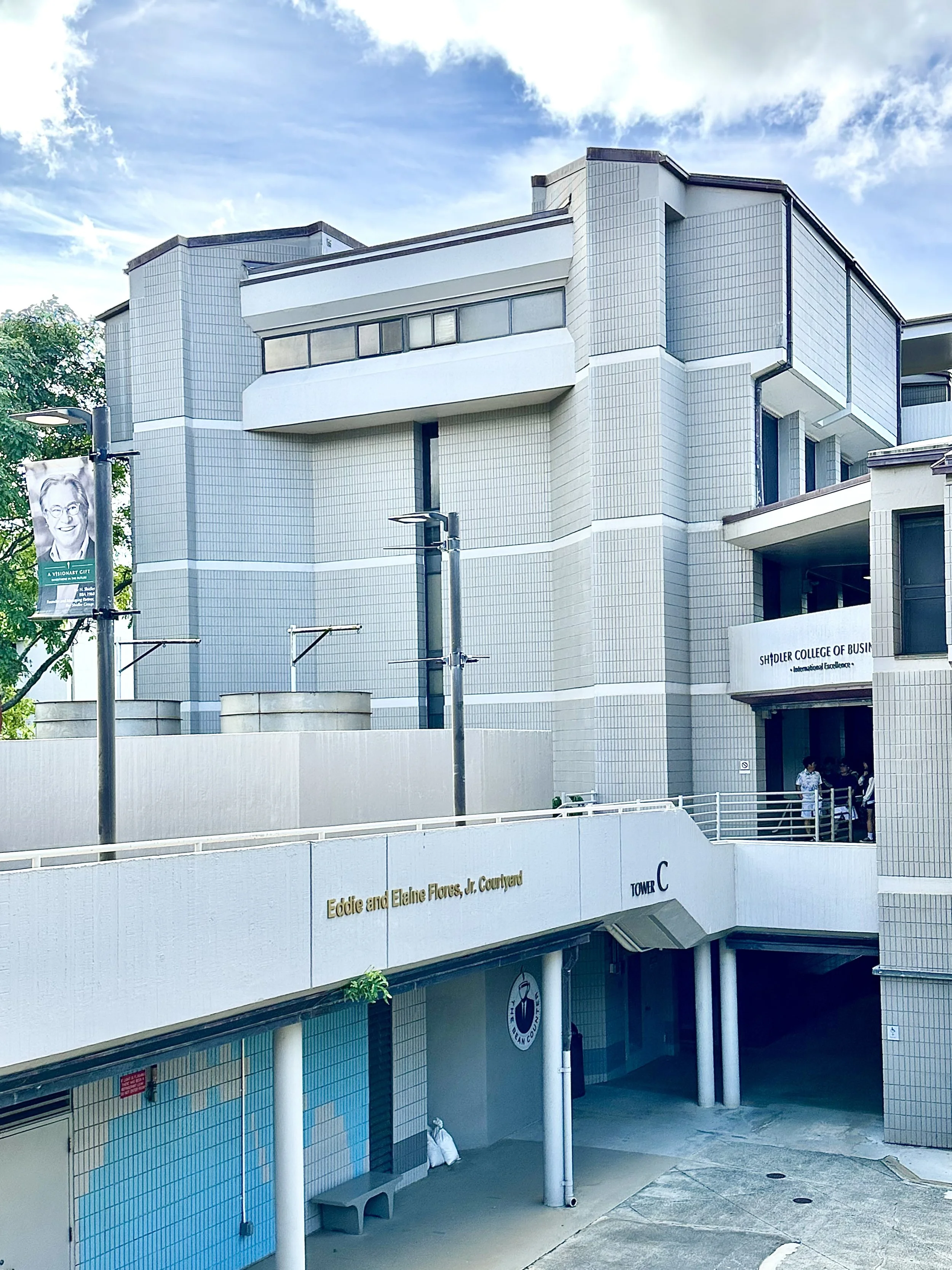
The sculpture “To the nth Power” (1971) by C.W. Watson is located on Maile Way outside of Shidler College of Business.
My siblings all graduated with business degrees from UH; I was the oddball that didn’t. I imagine they spent a lot of time at Shidler.
Gate of Hope, 1972 Alexander Liberman
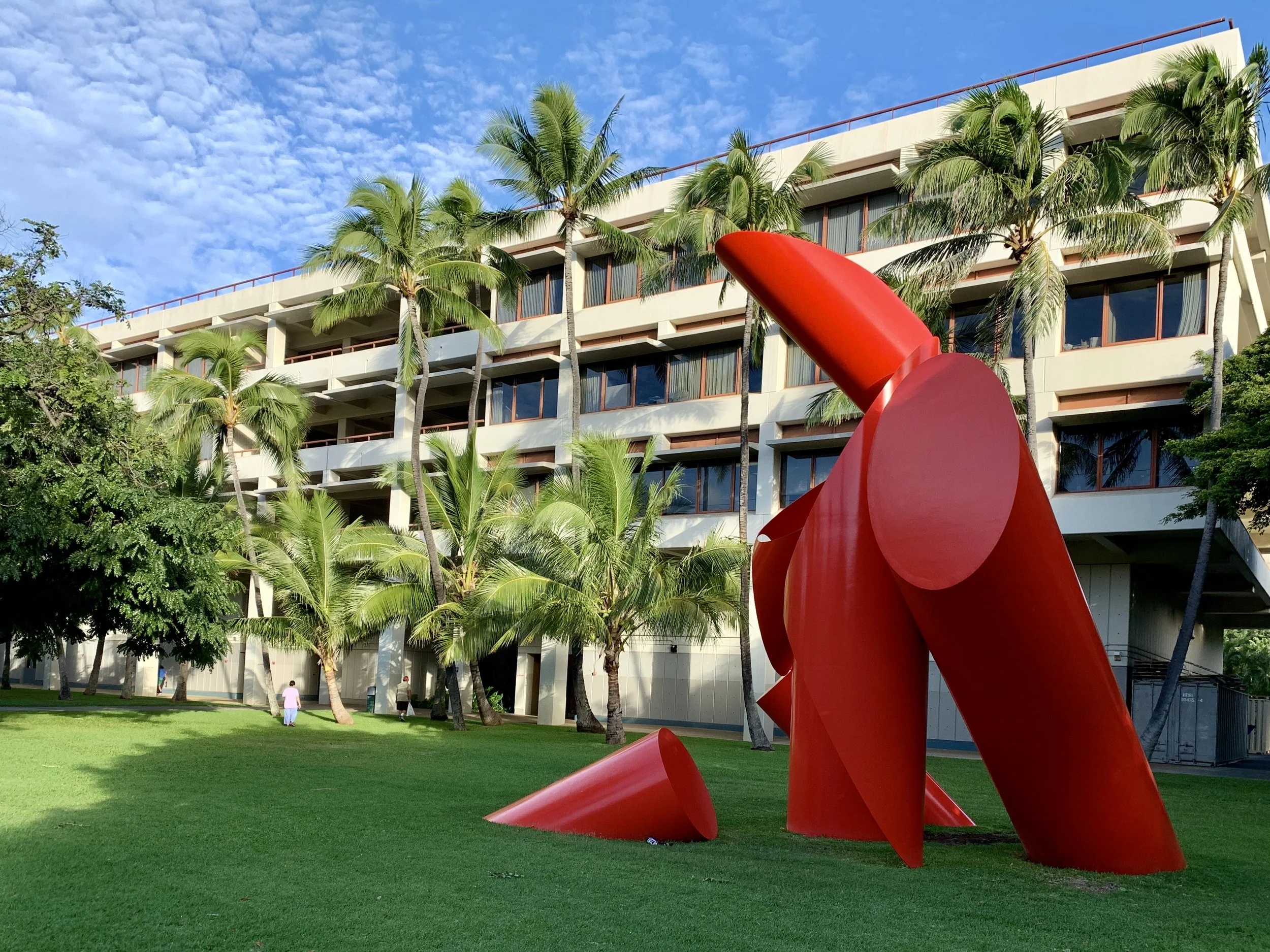
Right off of Dole Street, on Holmes Hall Lawn, is a tall red tube-like sculpture named The Gate of Hope. The sculpture was refreshed in 2017 with a new coat of paint.
Liberman was a British-turned-Russian national who served in the French Army and worked at Vogue Magazine in the 1940s. The sculpture’s supposed purpose is to suggest man’s ability to build complex structures through the understanding of engineering principles.
Untitled Sculpture Isami Enomoto, 1964
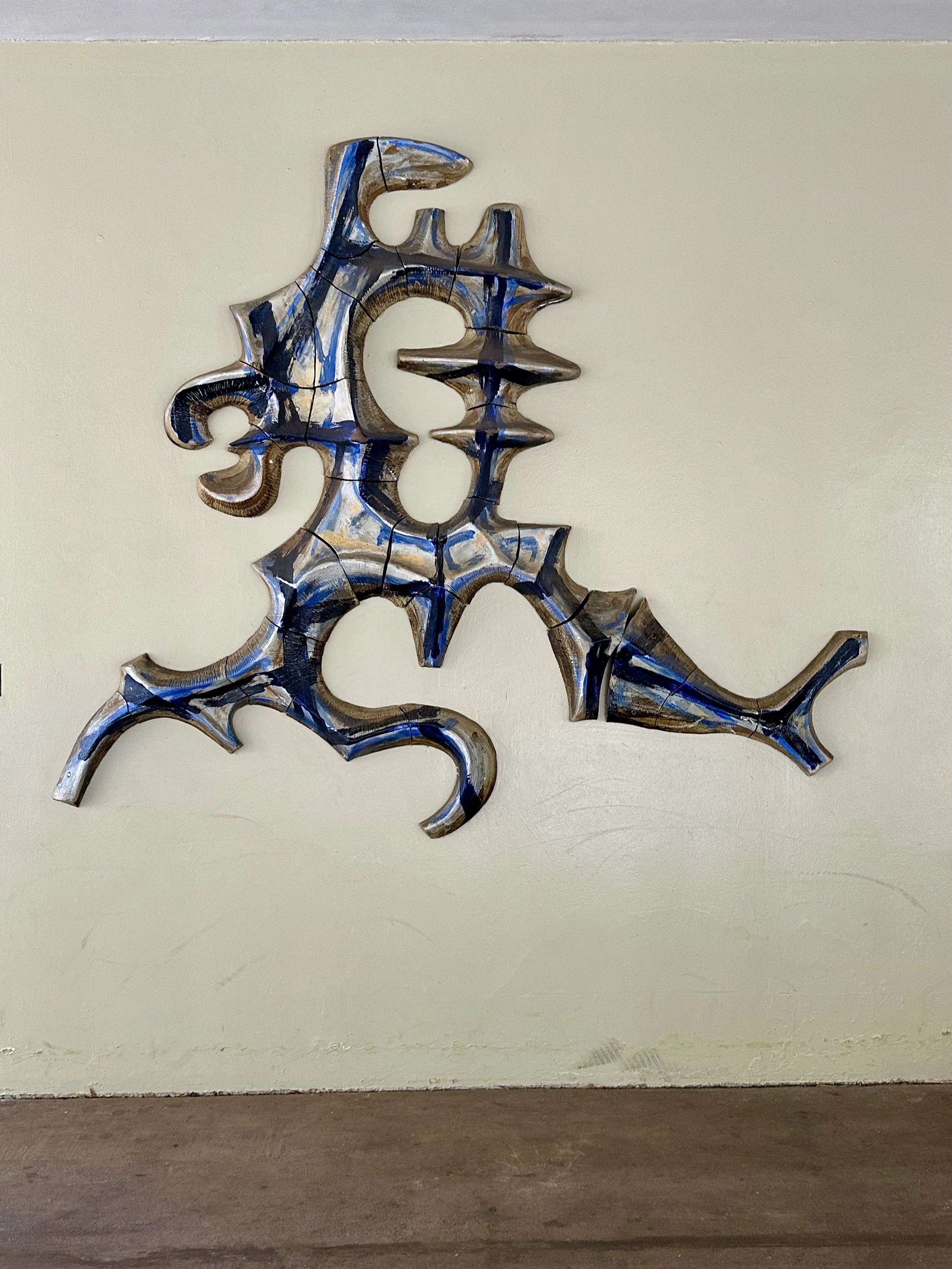
This ceramic wall sculpture outside Kuykendall Auditorium once formed one work with four nearby fountainheads, unifying the building's two wings and the plaza that links them. Water trickled slowly over the irregularly shaped fountainheads.
Enomoto studied commercial art at the University of Hawaiʻi at Mānoa and while completing his degree was told to take a ceramics class from "Horan" where he met Claude Horan. Having never been exposed to working with clay he fell in love with the medium and changed his major to ceramics.
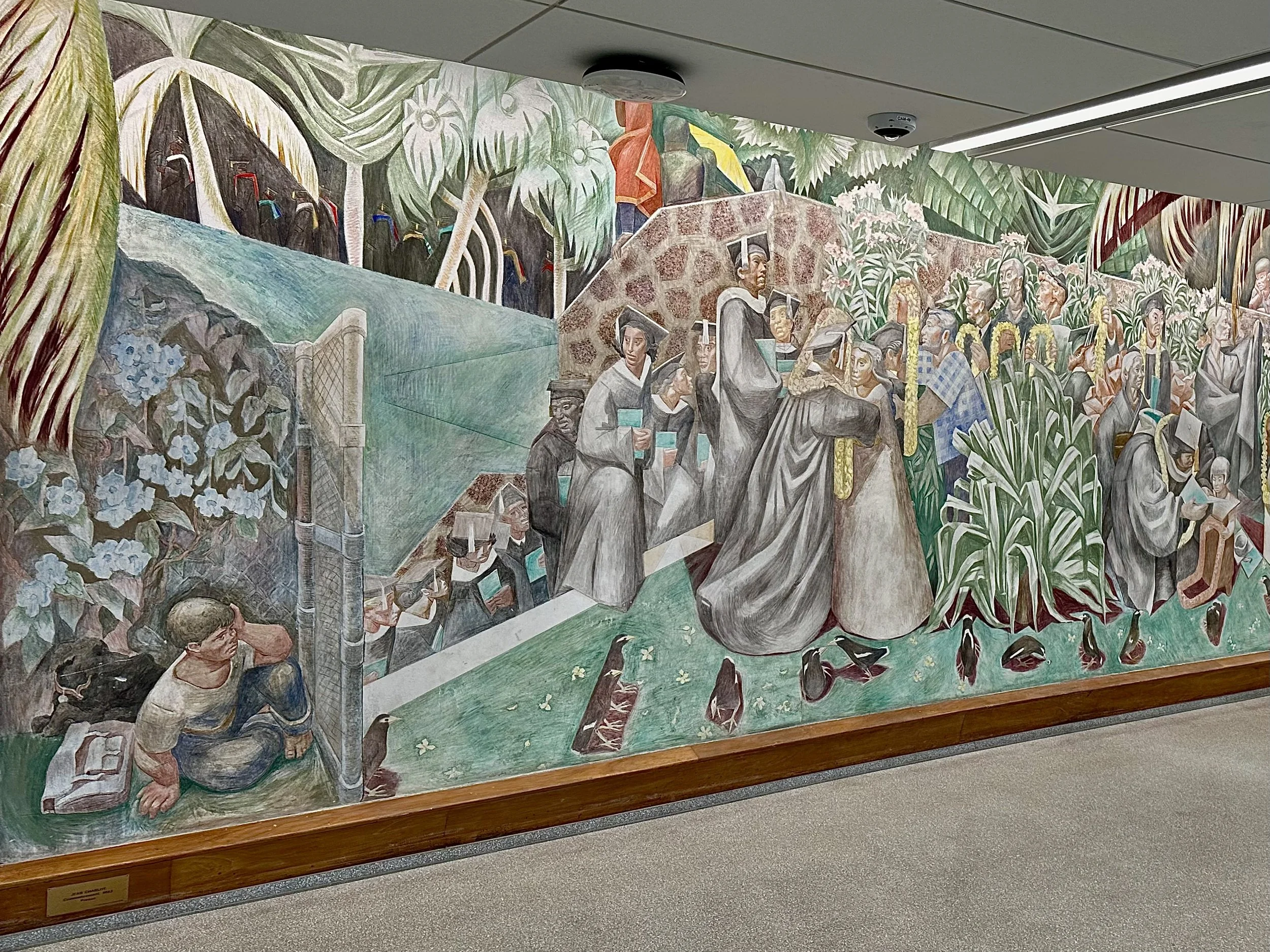
Commencement (1953) by Jean Charlot, Bachman Hall
Bachman Hall had been undergoing a multiyear renovation which completed in March 2024 when I visited. The day I was there, staff was in the process of moving in.
I asked the electrician if I could pop inside to take a look at the Jean Charlot murals and he said I could ask the security guard, who allowed me to explore.
The second-floor fresco, “Commencement” (1953) depicts the presentation of lei to graduates at Andrews Outdoor Theatre. Mynah birds along the mural’s edge repeat the stylized theme of the waiting parents. Source: uhmuseumstudies Flickr feed
The Relation of Man and Nature in Old Hawai'i (1949) by Jean Charlot, Bachman Hall
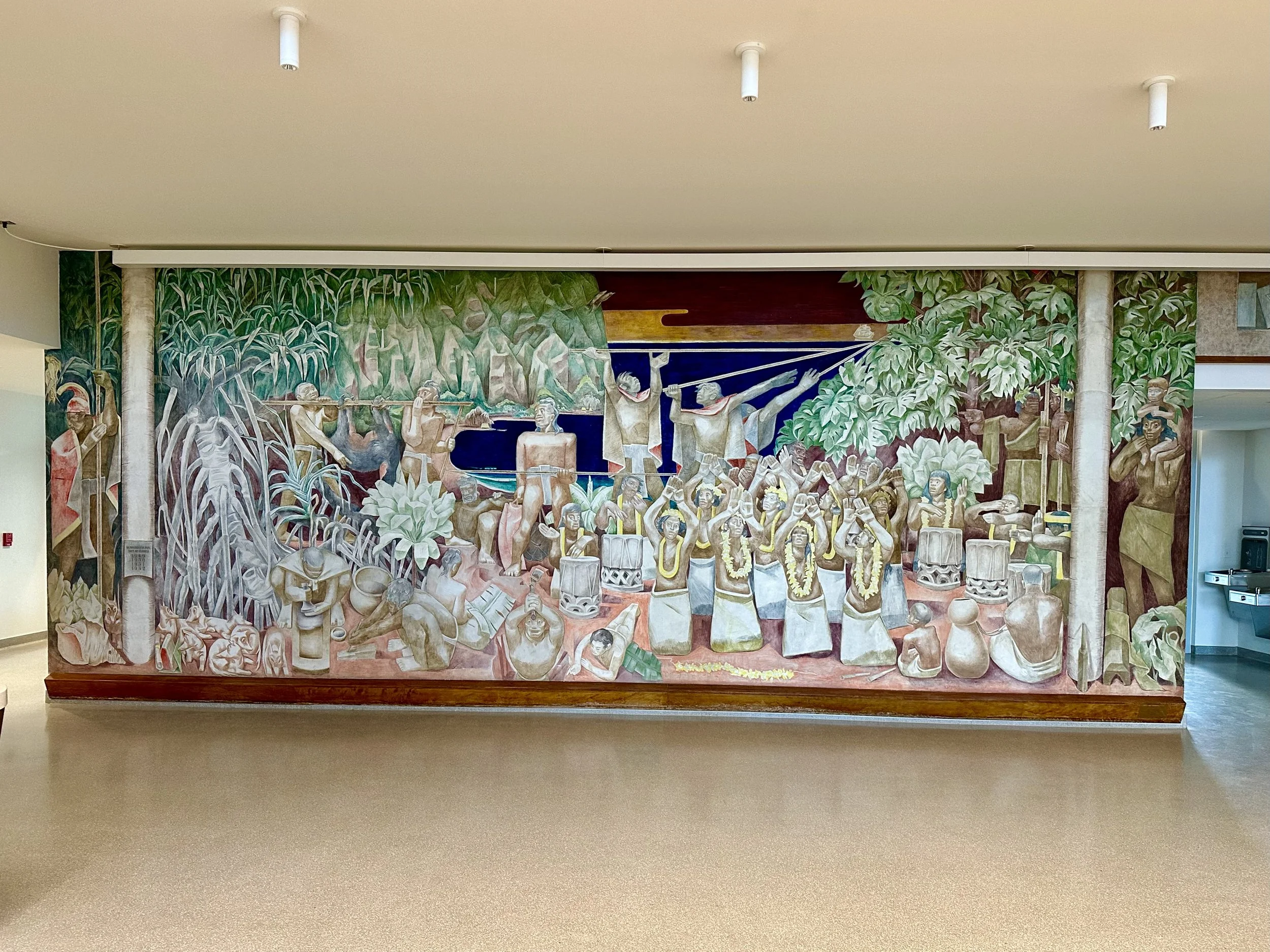
The ground-floor fresco depicts a Hawaiian feast with Captains Cook's Ship in the distance.
Source for the building info below was found online under Tropical Modernism at the University of Hawai‘’ at Manoa exhibit at Haigo & Irene Shen Architecture Gallery:
Bachman Hall, built in 1948, was the product of the partnership of Associated Architects, with Vladimir Ossipoff (1907-1998) serving as principal designer. In addition to Ossipoff, the collaboration consisted of architects Philip Fisk (d. 1958), Allen Johnson (1906-2000), Thomas Perkins (d. 1996), and Alfred Preis (1911-1993). Bachman Hall is distinguished by its unusual arrangement of spatial volumes, employing a pierced screen, “false” walls and windows, an open courtyard defined by square columns (and planted with contrastingly curving coconut palms), and a dramatic two-story entryway. The building has special significance for the architects’ collaboration with French-born muralist Jean Charlot (1898-1979), one-time student of the Mexican artist and revolutionary Diego Rivera (1886-1957).
Night Hula (1961) by Jean Charlot
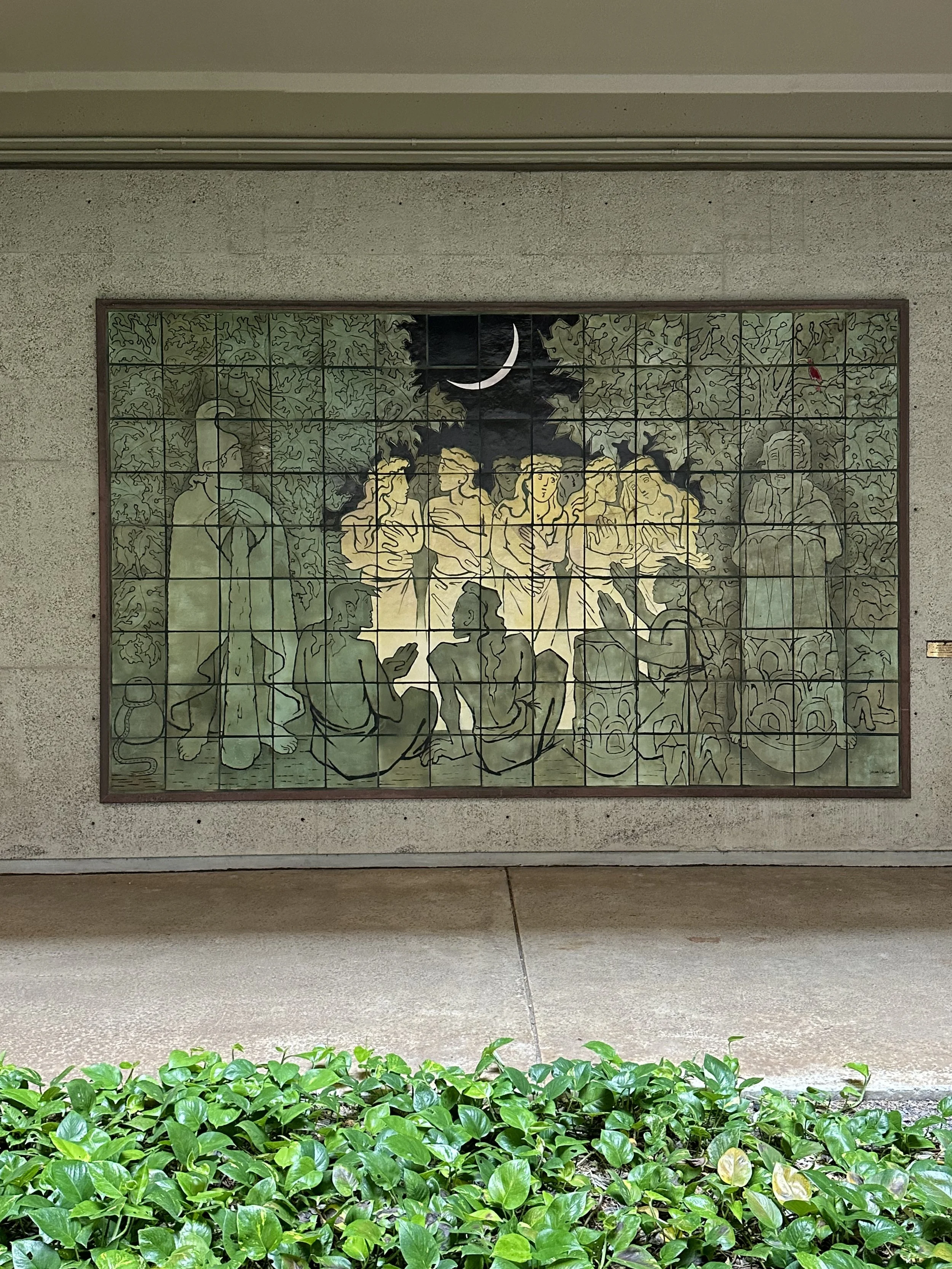
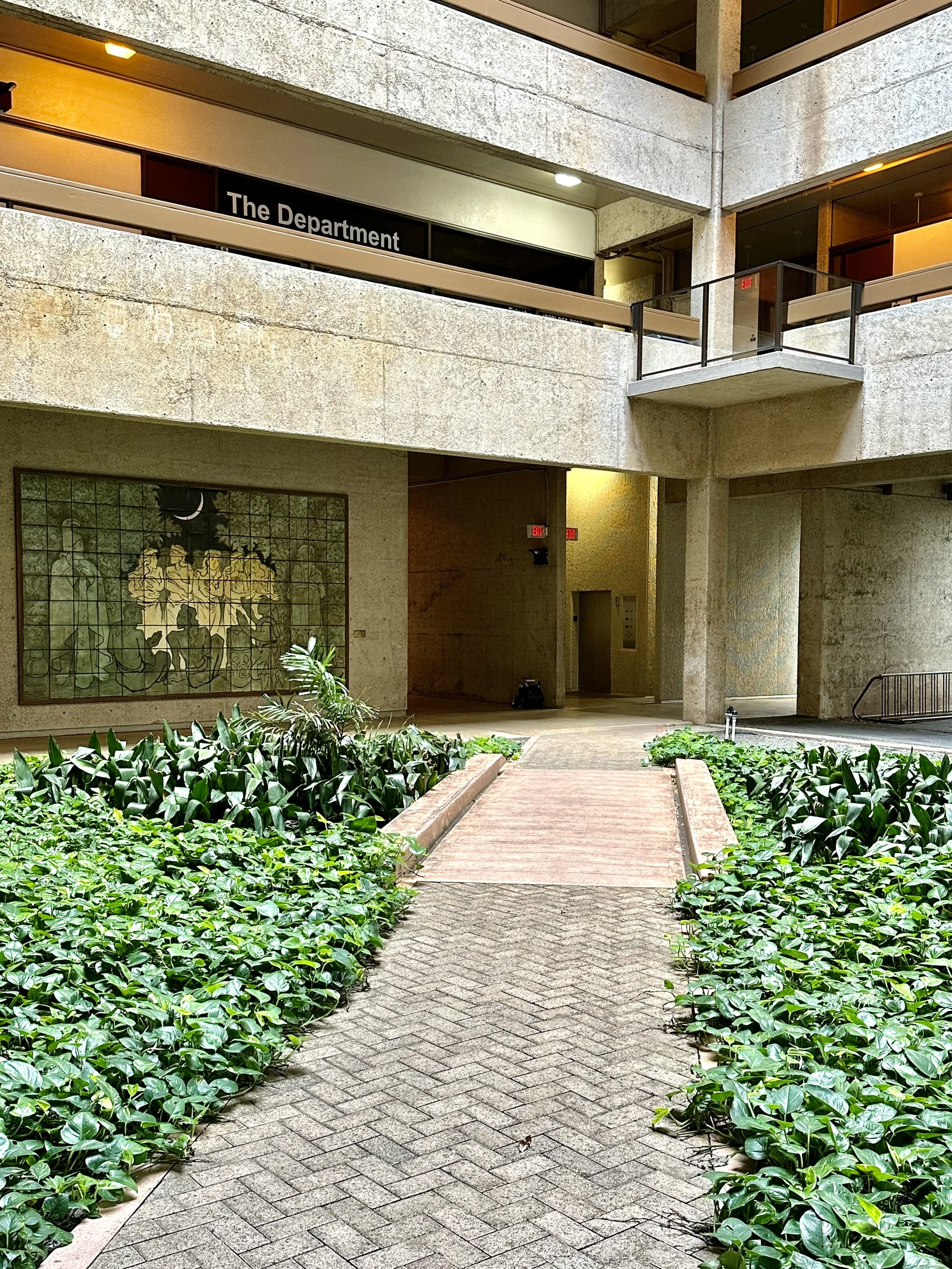
The ceramic tile mural Night Hula by Jean Charlot depicts Hawaiians celebrating with dance under a crescent moon. The mural was restored by Laura Ruby and Martha Ridgley in 2002.
The mural is installed on the north wall of the garden courtyard in Saunders Hall.
Saunders Hall, built in 1974, was designed by the firm of Ossipoff, Snyder, Roland and Goetz, with Sid Snyder serving as the principal architect.
Stained Glass by Murray Turnball in Keller Hall
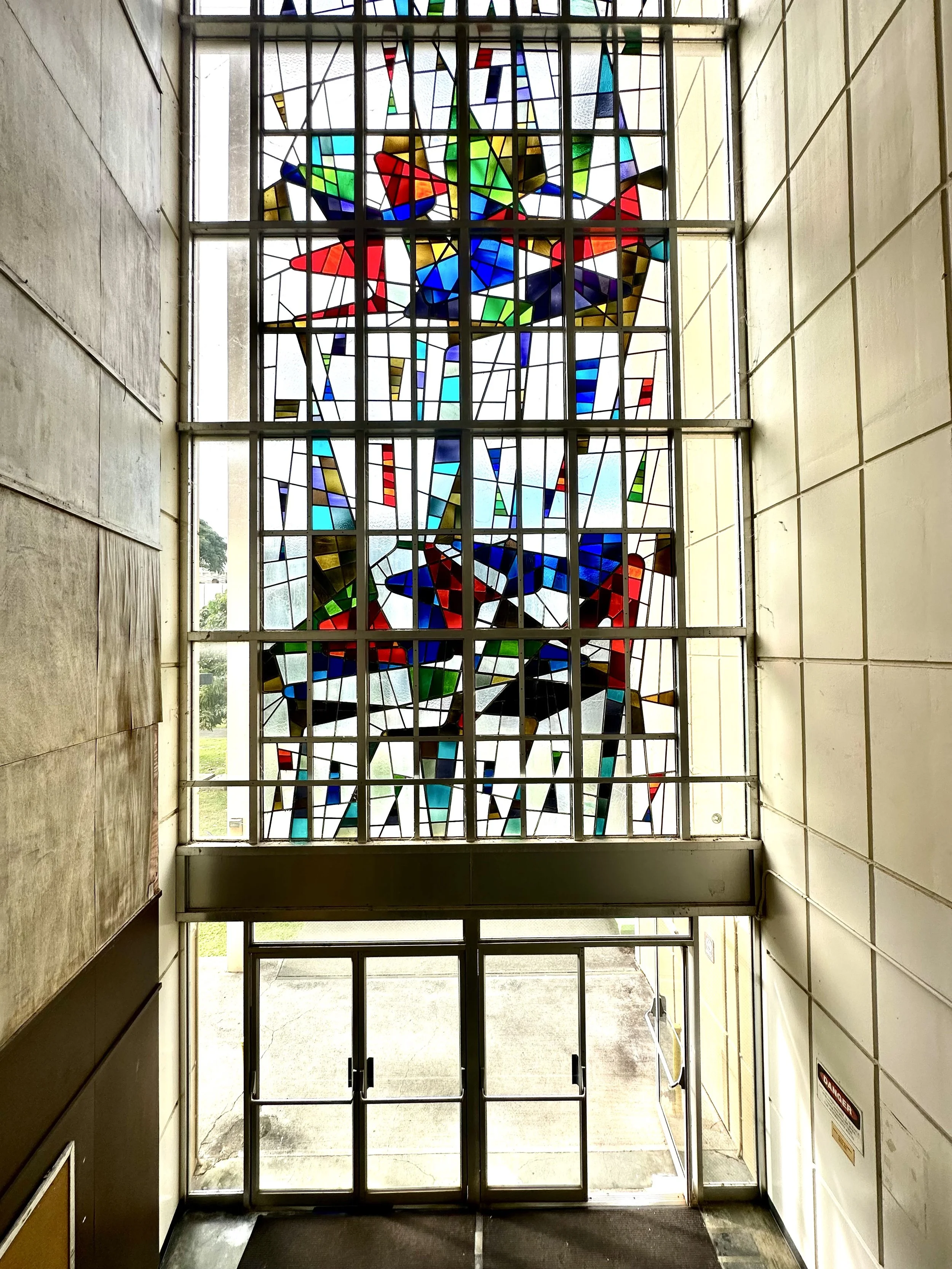
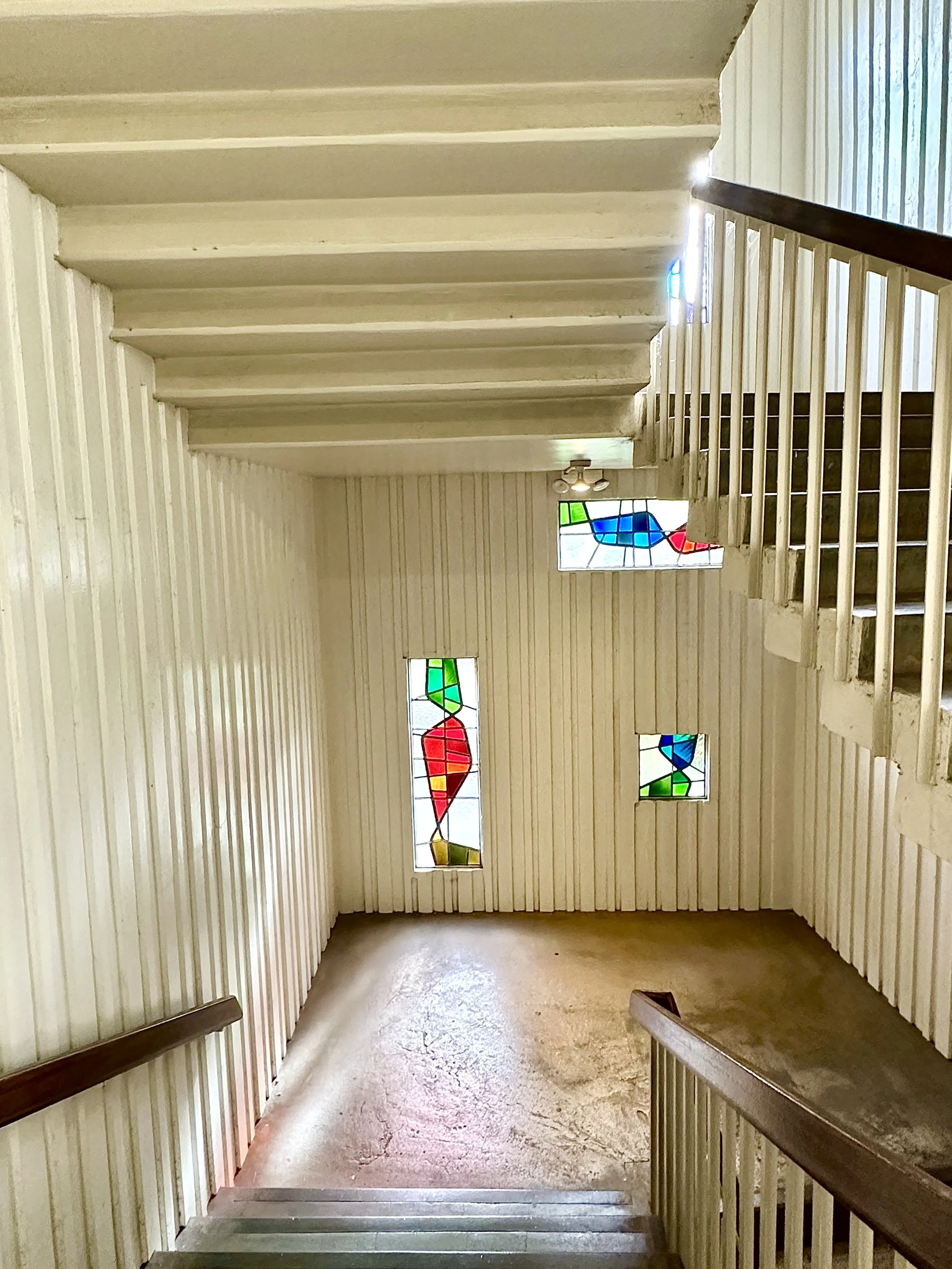
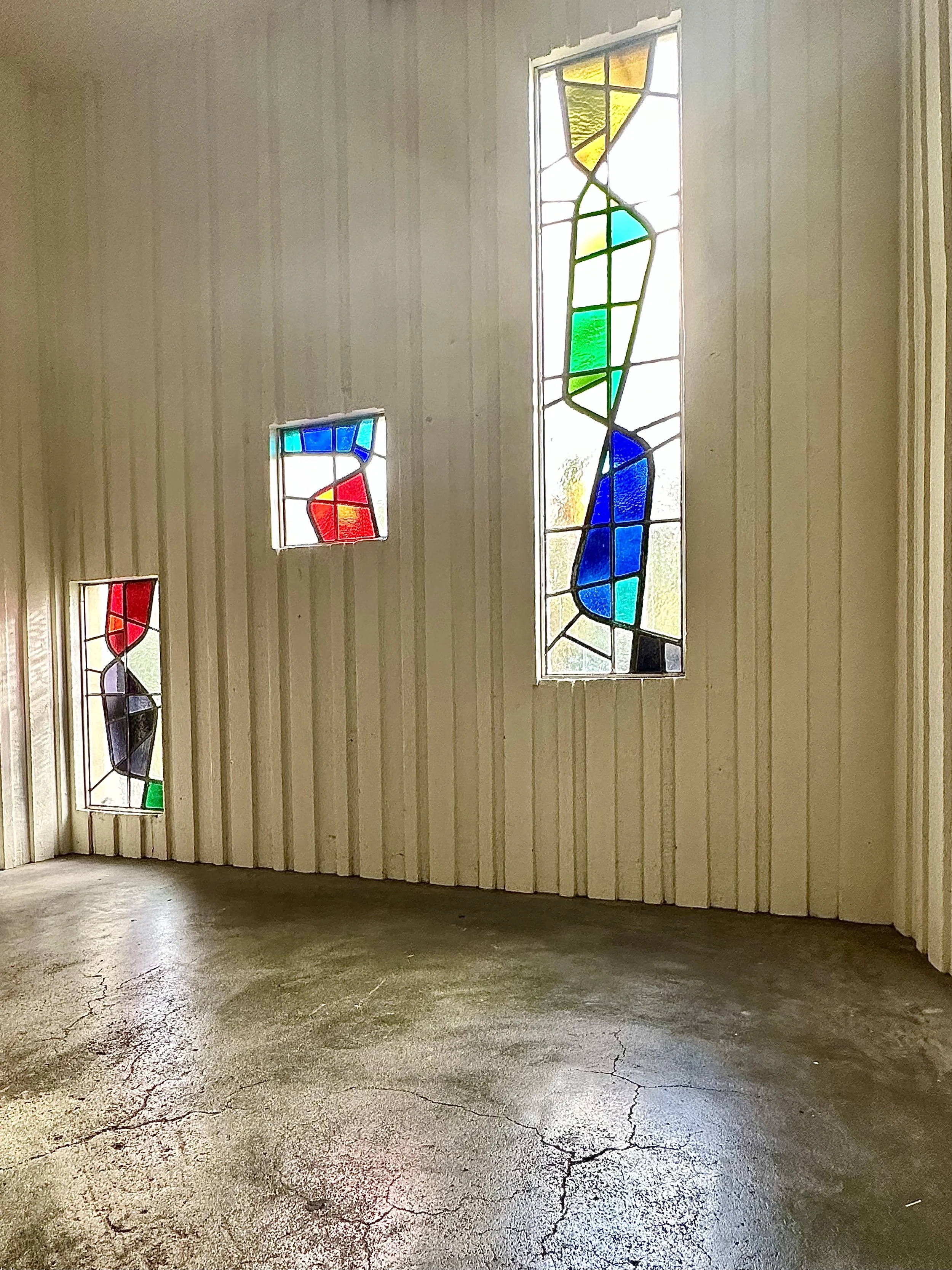
The 4-story Keller Hall designed by Clifford F. Young in 1959 is currently home to the Department of Mathematics. The building boasts some very unique stained glass windows by artist and one time University of Hawaii art professor Murray Turnbull.
The Fourth Sign Tony Smith Fabricated in 1977
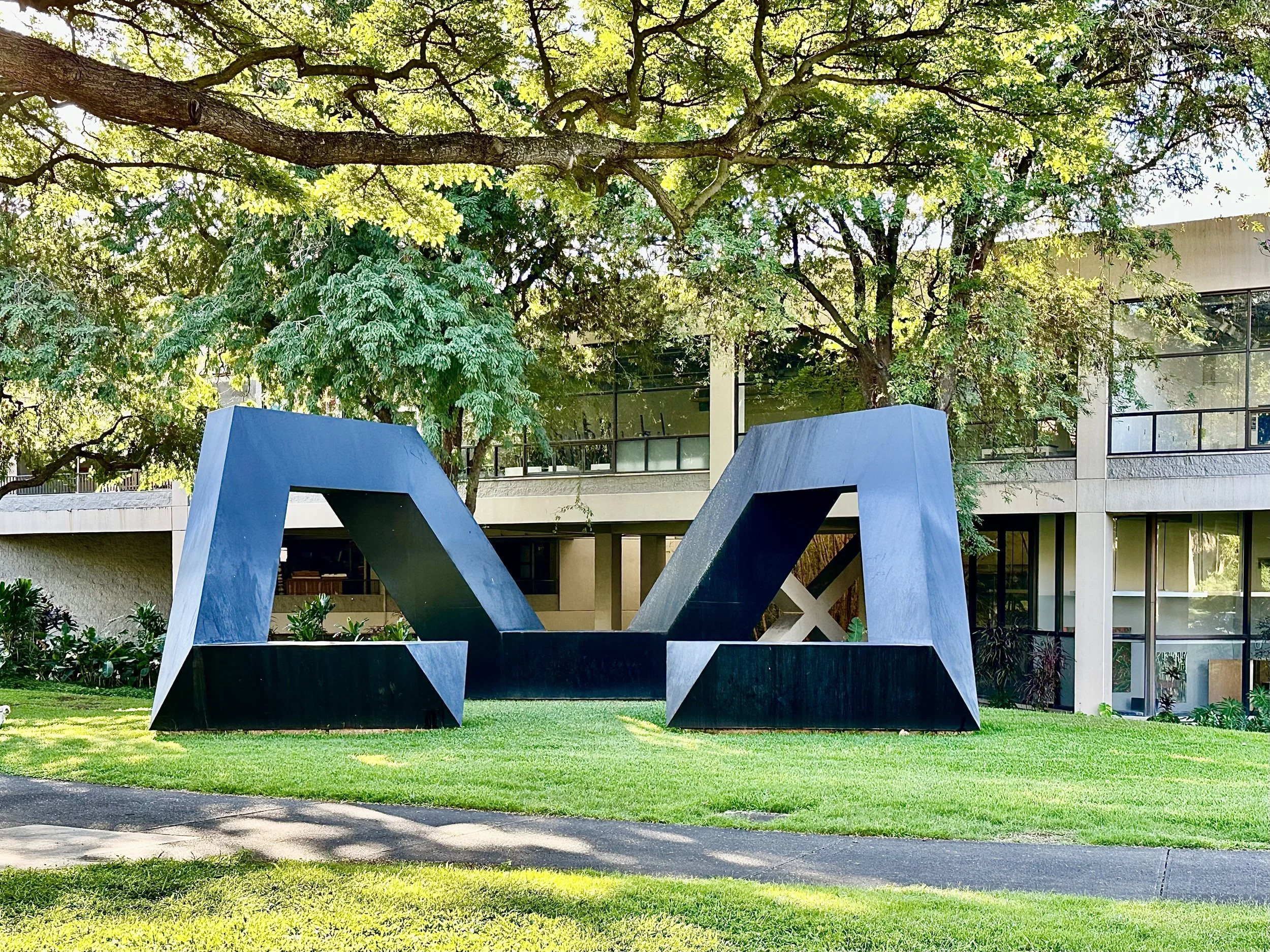
The Fourth Sign is a public artwork by the American artist Tony Smith. The large sculpture is installed on the lawn outside the Art Building at the University of Hawaiʻi at Mānoa.
Fabricated in steel and painted black, it signifies the fourth Zodiac sign Cancer (a crab).
Smith visited Hawaii in the summer of 1969 by university invitation to teach a sculpture course. He contemplated two other projects for the campus (Haole Crater and Hubris), but only The Fourth Sign was realized.